

Cybernette
An experiment in what people feel, decide and do when an AI takes control of their body, and what that means for designing autonomy.
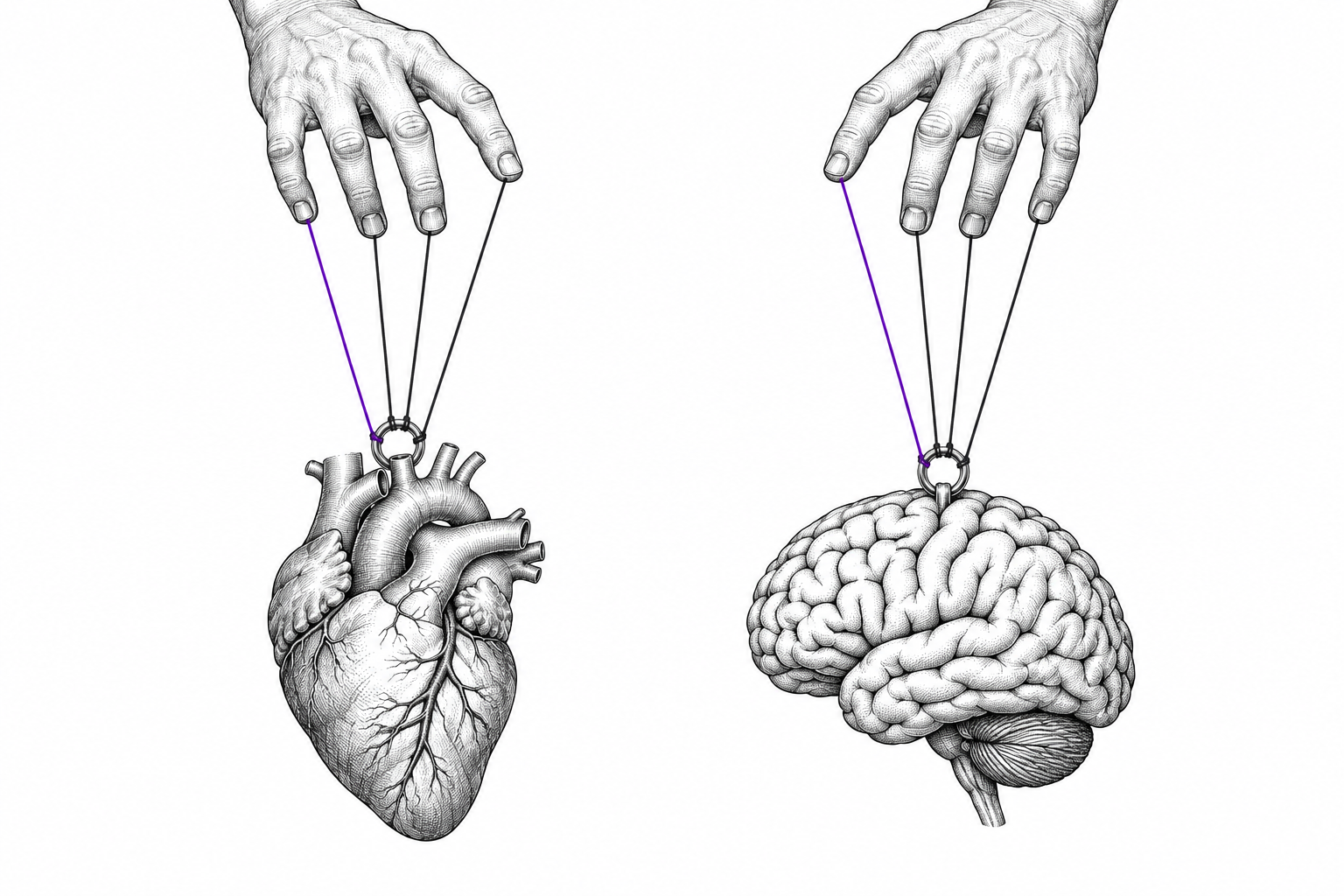
Overview
Cybernette is an experiment in the situation most AI products avoid testing: a person who has handed control to an AI. I built a system in which an adaptive AI moves the human body, and I studied how people respond to it, including myself as the first to go through it in public.
In interaction design the locus of control is expected to stay with the user. Cybernette removes it on purpose, to see what happens at the extreme: what a person feels, whether they accept it, and at which point they want control back. The participant hangs in a cable harness on a 4 × 4 × 4 m stage platform. Motors pull the cables, and an AI, not the participant, decides how the body moves.
I treated the work as research into human-computer interaction as much as a work of art. Its argument is that uncomfortable interactions, designed with care and inside an explicit ethical frame, can help build meaningful experiences: they turn attention inward, intensify presence and make people notice how much of their everyday behavior is already shaped by algorithms. The questions it raises are the ones AI products face now: who is in control, who is the author, and how far do people trust a system they cannot steer?
It was developed as a doctoral art project in Digital Arts at the University of Arts in Belgrade, positioned as art and science work. After three weeks of testing with different participants in different locations, I performed it publicly on 14 November 2019 at the FESTUM festival, in the Great Hall of the Student Cultural Centre in Belgrade.
Key facts
- Context
- Doctoral art project, Digital Arts, University of Arts in Belgrade (Interdisciplinary Studies)
- Format
- Transmedia performative experiment
- My role
- Author, researcher and first public participant
- Method
- Live sessions with participants, observation and a first-person account
- Pre-testing
- Three weeks, with different participants in different locations
- Premiere
- 14 November 2019, FESTUM festival, Student Cultural Centre, Belgrade
- Session length
- 3 minutes at the premiere
- Follow-up study
- 100 volunteers with experimental psychologists, postponed in 2020 because of the pandemic
- Thesis
- September 2020 (in Serbian, with an English abstract)
- Focus
- Human-AI interaction, control, authorship and trust, technophobia
How the experiment worked
The setup
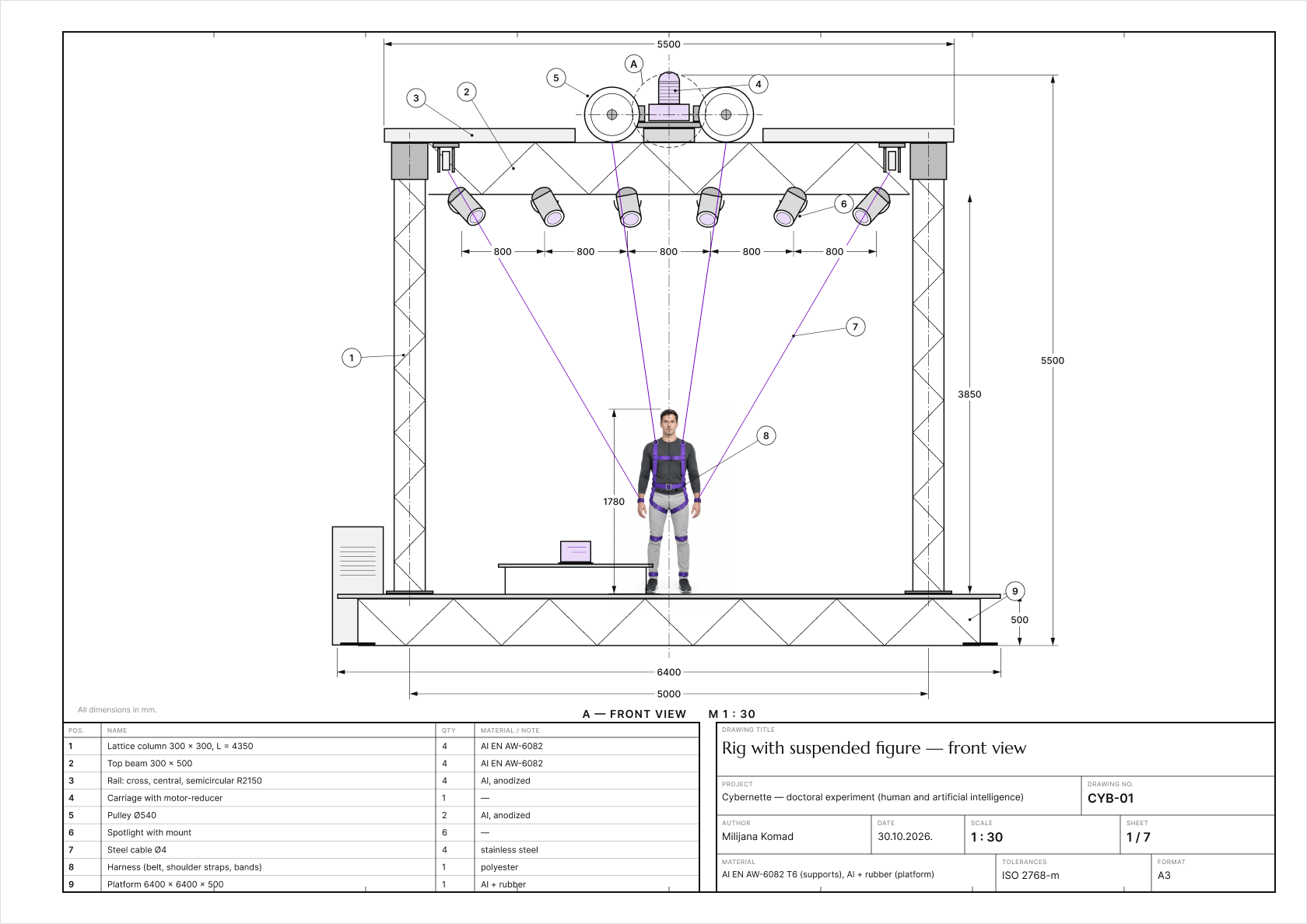
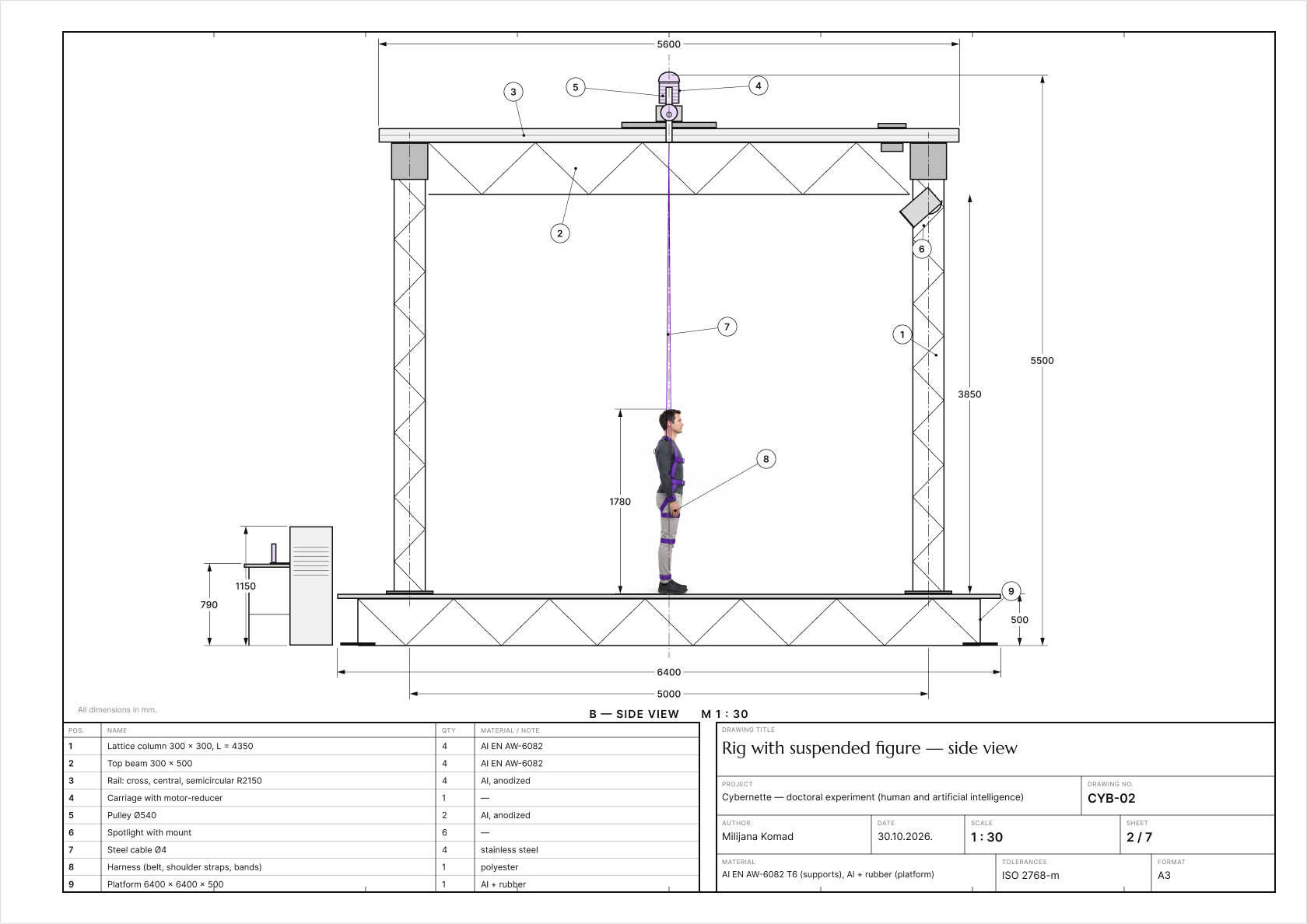
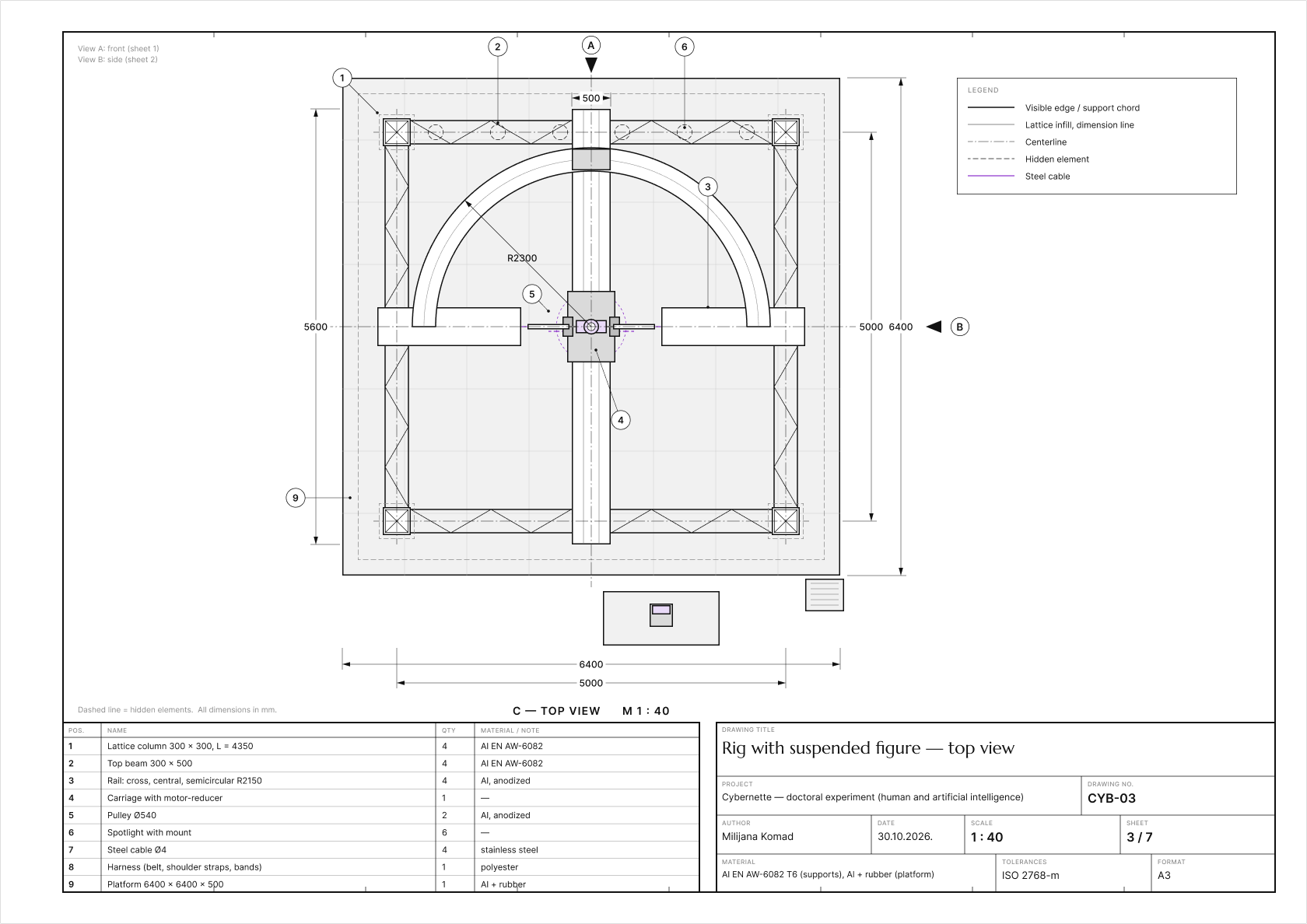
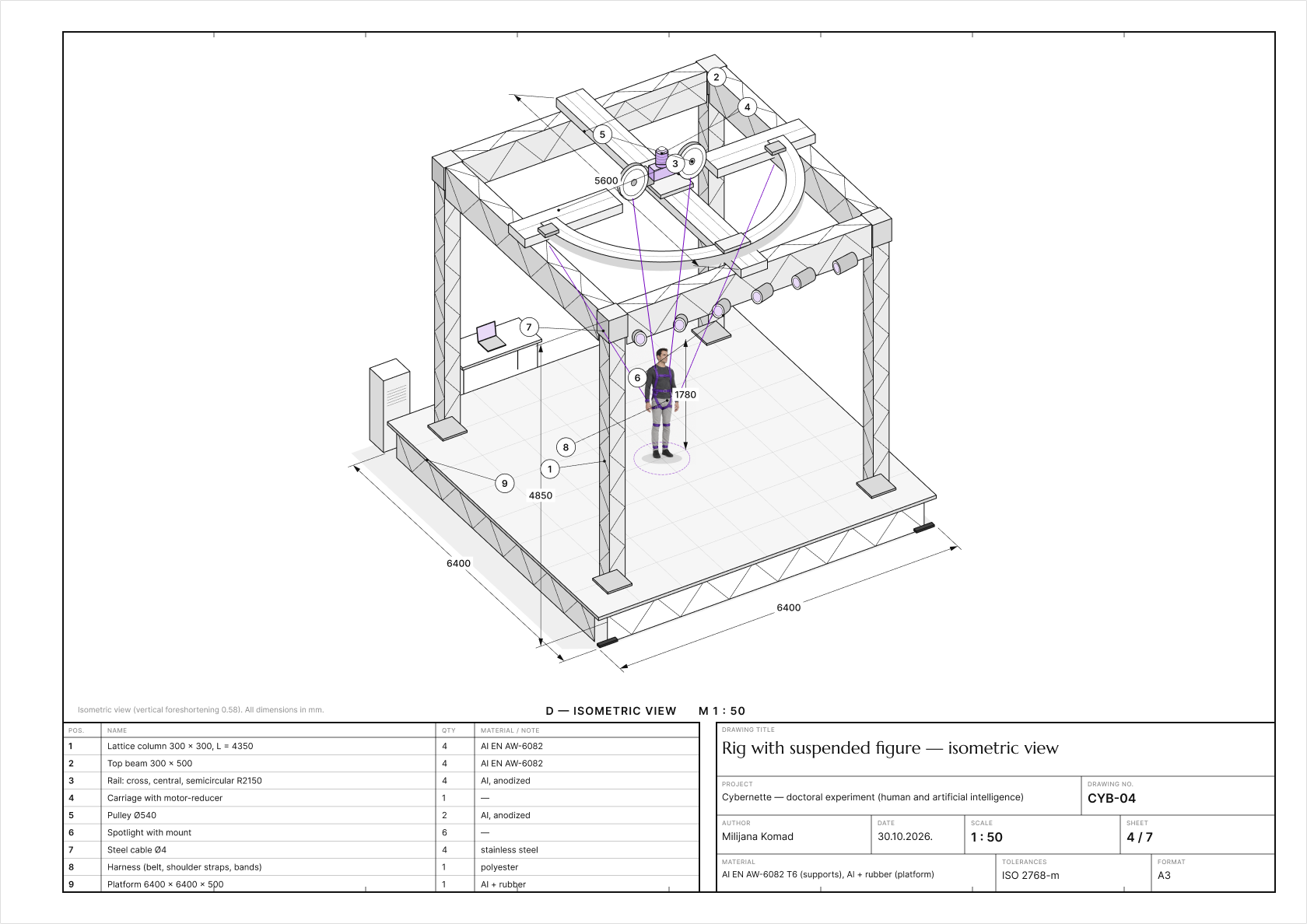
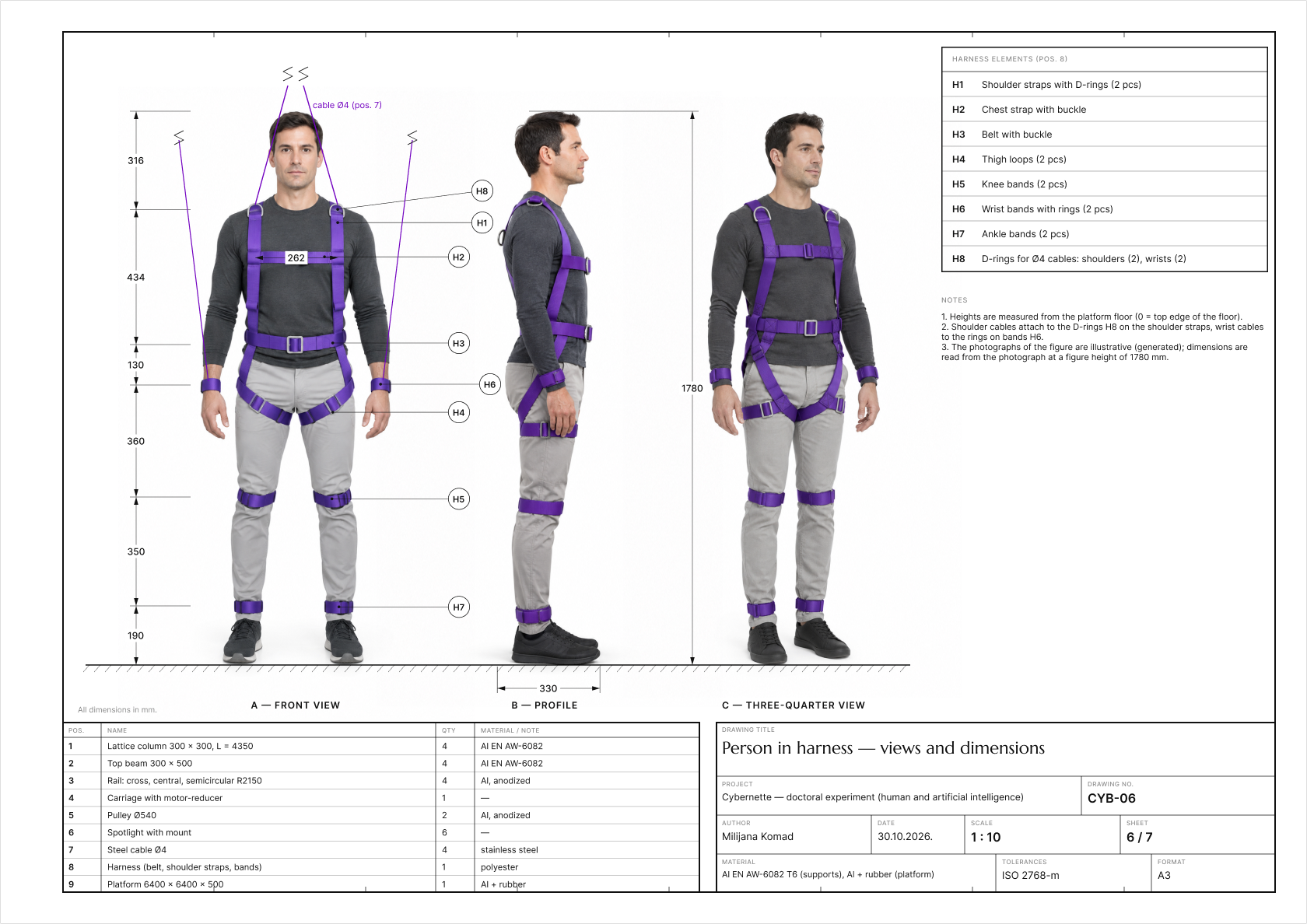
The participant hangs relaxed in a harness attached to cables. The cables are pulled by electric motors mounted at the top of a 4 × 4 × 4 m platform, and the motors are connected to a computer running the application.
An AI with two layers
The control layer is the AI. It starts from a base of 36 arm and leg movements and combines them at random into new sequences. On top of that I added a layer that learns about each participant: height and weight, level of surrender, whether they resist, and whether certain movements bother or hurt them. It adjusts the angles of the arm positions, learns from its mistakes and follows the beat of the music. The execution layer, electronics and motors, turns those decisions into physical movement.
Autonomy with a safety frame
A human operator confirmed every next set of movements, and a safety system surrounded the mechanism. Team members stood by the safety switch. Nobody could steer individual movements: at the premiere the software drove the motors and cables entirely on its own.
Technical drawings
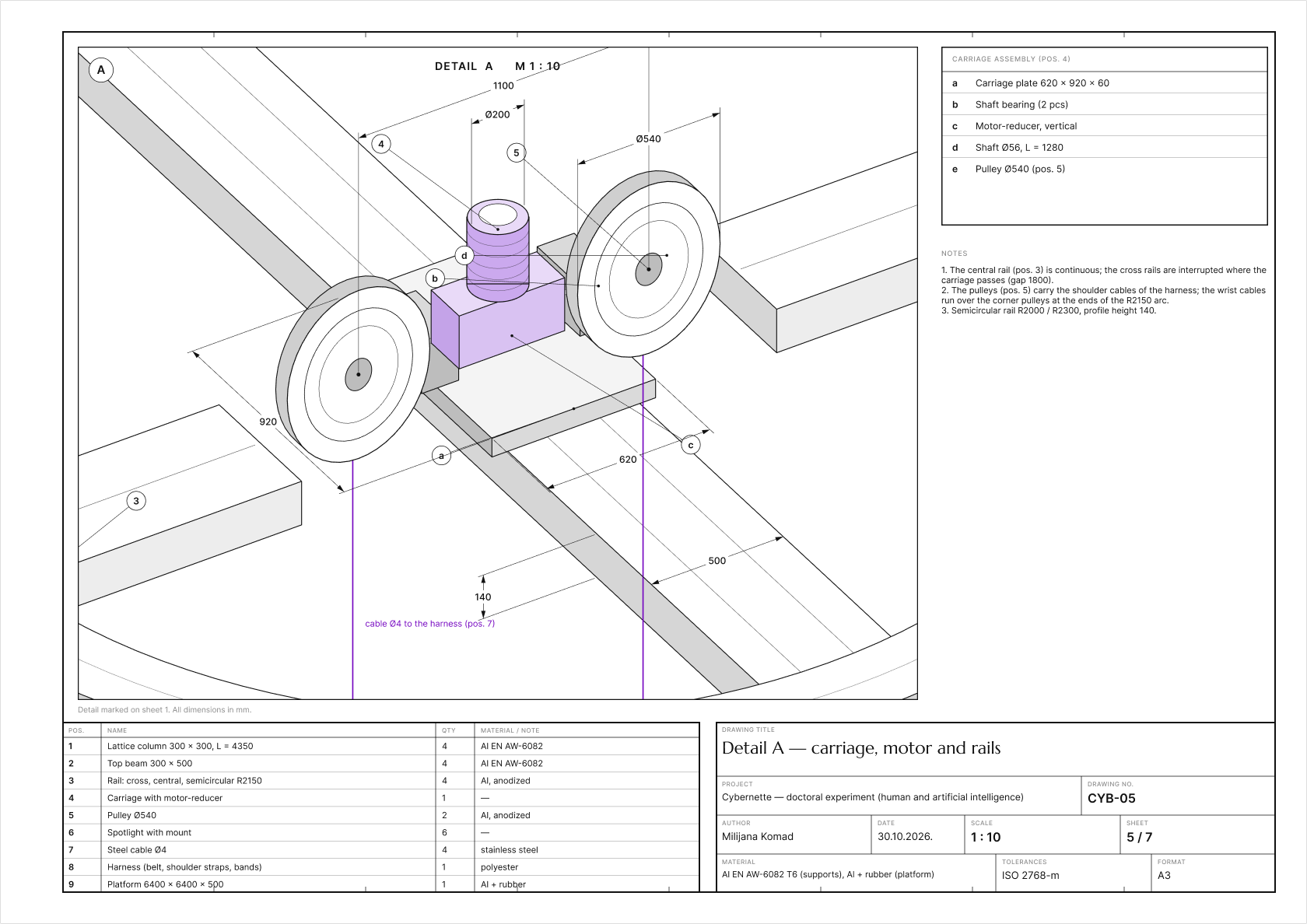
Six drawing sheets of the rig and the harness, redrawn from my 3D renders of the stage: orthographic views, an isometric view, a detail of the carriage and the measurements of the participant. All dimensions are in millimetres.
Designing the session
Anticipation
The audience entered the hall early and watched me test the equipment with the team. We then staged a false alarm and asked everyone to leave, and they waited outside for fifteen minutes before coming back to a dark hall and a dim side light. The tension was deliberate: the experience begins before the interaction does.
Framing
A voice from speakers all around the hall, a text I had written in advance, announced that I was giving up my will to the AI, that nobody, including me, could control what the machine did, and that I could not know whether I would be hurt.
The tactics around control
The work uses a small set of tactics, each applied only at certain moments: full inversion of control, isolation from the support of friends and family, exposure to strangers, and an engaged audience. A participant is alone with the system under a spotlight, watched by people they cannot see, which removes the anonymity of a crowd.
The session
Three minutes in near silence under a spotlight. The only sounds were the cables, the motors and the music written for the occasion.
The ending
Afterwards the audience was invited to sign up and try it themselves, and to share what they felt. I designed the ending as carefully as the beginning, because reflection is what lets an intense experience be absorbed.
What I observed
Reactions differed widely
When audience members tried it, some found it so uncomfortable that they asked for the session to be stopped, and others enjoyed it. The range interests me more than any average: tolerance for lost control is not a constant.
Even the person who built it was affected
I had tested the system before and had never had trouble surrendering control. At the premiere I was still afraid, mainly that something would go wrong with the motors. The three minutes felt timeless and my emotions were mixed. After a while of surrender I relaxed, and the fear gave way to something close to elation. I also felt a trace of technophobia toward what I had made.
The audience responded strongly
The audience watched in silence, and the session ended with ovations. Many seemed shocked by what they had witnessed.
What I can and cannot claim
These are exploratory observations. Only a small number of people had been through the system, most of them, including me, were deeply affected by the subject, and that is not enough to draw conclusions or to be objective. I planned a follow-up with 100 carefully selected volunteers and experimental psychologists, under an ethical framework informed by Milgram and Garfinkel, to be written up as a separate scientific paper. The pandemic postponed it in 2020.
Implications for product design
Treat control as a variable, and always provide an exit
Some participants wanted out and others wanted more. Autonomy of any kind, whether a recommendation, an automated decision or an agent acting on someone's behalf, should be visible, adjustable and reversible, with a way to stop that works at any moment.
Treat resistance as a signal
The system adapted to each participant, including whether they gave in, resisted or were bothered by particular movements. AI features should read signs of discomfort and adjust, not apply one behavior to everyone.
Keep a human in the loop where consequences are real
In Cybernette the AI proposes and a human operator confirms, within limits and a safety system. The principle carries over to any autonomous system that acts on people.
Friction requires consent
Deliberate discomfort can create focus and meaning, but only when people understand the setting and choose to take part. The work needed ethical thinking for the experience itself and for how it is studied.
Design the ending, not only the interaction
Reflection is what lets an intense experience be absorbed and shared. The closing of an experience deserves the same design attention as its opening: space to compare notes, to meet other participants and to take documentation home.
Chapters
Thesis chapters I-II. Introduces the work and its name, a coinage of mine from cybernetics, cyborg and marionette. The project starts from three instances: technophobia as the dual feeling of love and fear toward technology; AI and the open question of whether it creates or only generates; and transhumanism as a synergy of human and machine, where we must ask whether control can be handed over. The chapters trace how the idea grew from my earlier work on Baudrillard's simulation and simulacra, and how the body, movement and surface became the working material. They argue that the body is a historical and social construction, that everyday interaction with technology changes how we perceive it, and that the fear of technology splits into fear of hardware and fear of software, which converge. The key to overcoming a fear is to get to know its object. One question runs through the whole work: is human thought an algorithm derived from software written by the society we live in?
Thesis chapter III. Three figures frame the work. Baudrillard supplies the logic of simulation, the hyperreal and the code that increasingly organizes everyday life, and he was the starting point of the whole project. Philip K. Dick supplies the fake human and the question of what separates a person from a replica. Stelarc supplies the body as an extendable, enhanced interface, and a precedent for performances in which others, and networks, move his body; his work shaped the final form of Cybernette. Together they set up the inversion at the heart of the project: the machine as puppeteer, the human as puppet, and the AI as the being while the human takes the role of the non-being.
Thesis chapter IV. Five fields are examined: performance art and the live body; artificial intelligence, from its history and definitions to the “AI effect” and the question of who deserves credit when a machine makes art; transhumanism and its ethics; technophobia, its causes and its link to experience; and generative art, where autonomy and unpredictability are the rules and authorship is necessarily shared with the system. In generative art there are two acts of creation: one by the person who writes the rules, and one by the system that carries them out. I take that as the model for Cybernette: the AI is credited as a co-author with limited responsibility, and I keep responsibility for the risk to my own body. On AI and art, I argue that the test has three parts, technical ability, creativity and intent, and that machines could already imitate the first two when I wrote this.
Thesis chapter V, the core of the research. Traditional HCI aims at usability, fewer errors and satisfaction. This chapter asks what benefits come from deliberately putting people in a worse position, which forms that can take, how it fits into a complete experience and which ethical frameworks apply. Four effects are examined: interaction itself, the transhuman upgrade, heightened awareness and sociality. The precedents range from Abramović’s Rhythm 0 and Imponderabilia, Acconci’s Project for Pier 17 and Stelarc’s suspended and remotely controlled body to thrill-based installations and amusement rides. The chapter dwells on control: what it means to surrender it, to ask others to surrender it, and how isolation, intimacy with strangers and an engaged audience change the experience, including the discomfort of watching someone you care about lose control.
Thesis chapters VI-VIII. Describes the system and the performance as a designed experience with exposition, complication, climax, resolution and a deliberate reflective close. It sets out the planned 100-participant experiment and its ethical framework. The references are Milgram’s obedience experiments, Garfinkel’s ethnomethodology and the ethics committees that grew out of cases such as the Tuskegee study, and the work is positioned as art and science rather than clinical research. The conclusion argues against the idea that the body is obsolete: bodies adapt, the posthuman body is a cyborg body, and in a technological culture the honest formulation may be “I feel, therefore I am.”
In my product work
These questions follow me into product work: how much autonomy an AI feature takes, how visible and reversible it is, and how teams adopt it. A related case study: introducing an AI tool into teams at Bet365.
Exhibitions
- 2023he:sHeArtExhibition
2023 · Kaleidoskop kulture, Design District · Novi Sad, Serbia - 2020Immunity ShootPerformance
December 2020 · Live online video performance - 2019Cybernette, from Technophobia to TranshumanismPerformance
November 2019 · Student Cultural Centre (SKC) · Belgrade, Serbia